Walk for Cobalt 2026 - Landmarks

Enjoy the Walk for Cobalt 2026 and learn more about the landmarks you pass. Good luck on your chosen route!

Yellow Route: 5km Walk

Red Route: 7km Walk (additional 2km route)

Linton House

Find out about the full history of Linton House below. Was there anything you didn’t know?

Cheltenham Lido

Cheltenham Lido is a Grade II listed building. Constructed in 1934-1938 to the designs of G Gould Marsland for Cheltenham Borough Council in consultation with Edward White. It is complete with all key ancillary buildings including an entrance block, detached changing wings and shower blocks, sun decks, café with terraces and plant house. The children’s pool and changing rooms have been altered and refurbished in the late- 20 and 21 century, and the pool refurbished and strengthened in 2006.

Whish Sister's fountain

The fountain was donated by the three Whish sisters to the town. The sisters had been long members of the church and donated the fountain in 1981 to commemorate their 50 years as Cheltenham residents. 

The Playhouse

 The Montpellier Baths opened in 1806 and was an extensive establishment for its time. As now seen, it is a classical building with three Doric entrances.

The Corporation purchased the baths in 1898. Changes then made included a swimming pool, but its popularity waned and in 1945 the building was converted to a theatre for amateur use.

The floor of the auditorium was built over the swimming pool, originally as a flat floor venue, the seats not being fixed.

Elephant Invasion Mosaics

Can you find the elephant invasion mosaics tucked down the alleyway by John Lewis?

In 1934, three elephants from Chapman’s Circus visiting Cheltenham were paraded through the town and one of them invaded a local seed merchants! Whether it was a deliberate publicity stunt – who knows?

The Brewery Quarters

Cheltenham’s first proper brewery was founded in 1760 by local maltster and baker, Thomas Gardner on this site. Gardner’s Brewery flourished and expanded and in 1888 was registered as Cheltenham Original Brewery Ltd.

Cheltenham’s association with malting and brewing goes back to medieval times when it was a cottage industry. Ale, sometimes flavoured with herbs and spices, was a necessity to avoid catching many waterborne diseases.  The addition of hops around the 1500s saw the start of the brewing of beer.

By the 20th century, the site contained extensive malting, brewing, cooperage and bottling facilities.Mergers, takeovers and redevelopments continued throughout the rest of the brewery’s life, the final one being Whitbread in 1963.In 1998 the Brewery closed and the site was redeveloped. Now known as the Brewery Quarter

Edward Jenner

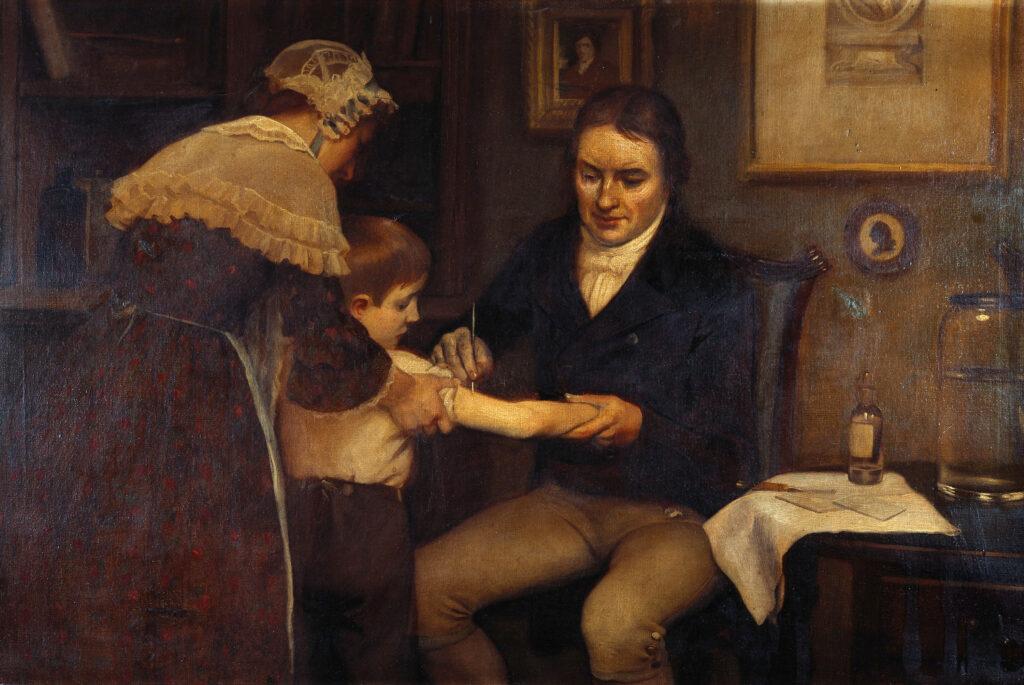
Like any other doctor of the time, Edward Jenner carried out variolation to protect his patients from smallpox. However, from the early days of his career Edward Jenner had been intrigued by country-lore which said that people who caught cowpox from their cows could not catch smallpox. This and his own experience of variolation as a boy and the risks that accompanied it led him to undertake the most important research of his life; the world’s first ever vaccination!

Jenner’s newly proven technique for protecting people from smallpox did not catch on as he anticipated. One reason was a practical one. Cowpox did not occur widely and doctors who wanted to test the new process had to obtain cowpox matter from Edward Jenner. In an age when infection was not understood, cowpox samples often became contaminated with smallpox itself because those handling it worked in smallpox hospitals or carried out variolation. 

The Wilson Art Gallery and Museum

The Wilson, formerly known as Cheltenham Art Gallery was opened in 1899. It offers free admission and has a programme of special exhibitions. It was renamed The Wilson in honour of polar explorer Edward Wilson in 2013 after the building was extended.

Edward Wilson was born in Cheltenham on 23 July 1872, the son of a local physician. His medical and scientific skills were matched only by his artistic talent.

2012 marked the centenary of the British Antarctic Expedition (more commonly known as the Terra Nova expedition) led by Captain Scott. The Polar party included Edward Wilson who came from Cheltenham.

The Hare and the Minotaur

Created by Sophie Ryder. It featured at the Cheltenham Museum and Art Gallery and it was created in 1995. The overwhelming public response to the exhibition fuelled the campaign to retain one of Sophie Ryder’s sculptures and the Hare and Minotaur was acquired by public subscription in 1998.

Can you spot the pigeon? Legend holds that the springs upon which Cheltenham would be built were found in 1716, after a local noticed a flock of pigeons were particularly attracted to a patch of ground.

Cavendish House

Cavendish House is Cheltenham’s oldest, leading department store, established in 1823 on The Promenade. Now known as House of Fraser, Cavendish House keeps its original name above the shop as a reminder of the department store’s rich history. Also located in the basement of Cavendish House was a cellar. An unusual bottle of Whiskey was found, when clearing the cellar, which is estimated to cost around £15,000 today!

Article by Charlotte Cotteham

Edward Wilson Statue

Dr Edward Wilson was a leading member of Captain Robert Scott’s two Antarctic Expeditions. Scott’s second Antarctic Expedition became a race to the South Pole against Norwegian explorer Amundsen. The party, including Wilson, reached the South Pole on 17th January 1912 only to discover that Amundsen has arrived a month earlier. All of Scott’s perished on the return journey.

Neptune's Fountain

Neptune sits proudly atop the fountain, adorned in a mantle, and wields a trident. The portrayal of the sea horses, with sculpted balusters and vases filled with flowers surrounding the fountain, further adds to its grandeur. The sculptor behind this fountain is Yorkshireman Richard Lockwood Boulton. After Richard’s retirement in 1893, his four sons took over the family business and continued in their father’s legacy of sculpting and stone carving.

Cheltenham Town Hall

Built at the turn of twentieth century to accommodate the many balls and concerts of the town’s social calendar, Cheltenham Town Hall was, quite literally, made for celebrations. The total cost of the building, including its marbled Corinthian style columns, intricately decorated coved ceiling, dance-friendly sprung floor, beautiful balconies, internal decoration and fixtures and fittings was around £45,000! Standing proudly overlooking the immaculately manicured Imperial Gardens, Cheltenham Town Hall comprises of a grand Main Hall, varying sized dining and drawing rooms and offices.

Imperial Garden

Gustav Holst was at the heart of the renaissance in English music during the first half of the 20th century and his statue was unveiled on 4 April 2008. He is most famous for the composition of The Planets. Holst wrote that he was grateful for three things in his life: music, friendship and the Cotswold Hills. The Gustav Holst Memorial Fountain was made possible by the bequest of Miss Elizabeth Hamond. For many years Miss Hamond lived and worked in Cheltenham and was devoted to the town. In her will she left a generous legacy to the Cheltenham Civic Society to be used to benefit the town. The Civic Society decided that this would be used for a full-size bronze statue of Gustav Holst with an octagonal plinth depicting the planets.

The Holst statue, which incorporates seven plaques in the plinth depicting the Planets was sculpted by Anthony Stones FRBS, FRSA and cast at the Pangolin Foundry in Chalford, Stroud.

Montpellier Caryatids

These armless ladies are known as caryatids. These were inspired by the portico of the Erectheion Temple on the Acropolis in Athens. The Nottingham sculptor John Rossi was commissioned to make two statues in white-painted terracotta, which were used as a pattern for 30 copies carved in stone by local sculptors James Brown and his son William. The 32 caryatids now line the shops of the Montpellier Walk.

Montpellier Wine Bar

The most iconic wine bar in Cheltenham has been in its prime location since 1977. Always popular with both locals and visitors who were attracted to the bar due to its warm friendly atmosphere, a large selection of international wines coupled with delicious food. 

The Ivy

In 1826, Henry Thompson’s son Pearson Thompson asked John Buonarotti Papworth to oversee the project and it was during this period that the dome was erected. The dome is inspired by Rome’s Pantheon and has almost identical proportions. The building was used as a pumproom, with water from local wells, and ballroom with an additional billiard room and reading room.

William IV Statue

Can you find the statue of William IV hiding in Montpellier gardens?

King William IV reigned from 1830 to 1837 and was the third son of George III. He is the king who gave his royal assent to the Slavery Abolition Act of 1833, the law which abolished slavery in the British Empire.

King William IV died childless in 1837 when his niece, Victoria became Queen

Cheltenham College Chapel

Cheltenham College Chapel, The Chapel of St Mary & St George, was designed by Henry Prothero in 1891and completed in 1896 and is based on the designs of the chapels at King’s College Cambridge and Eton College.

The ceiling height is 55 feet. There are many memorials in the Chapel including 700 names of those lives that were lost in the Great War engraved in brass plaques on the walls.

The Exmouth Arms
You’ll find The Exmouth Arms at the heart of the Bath Road.
Pop in for a free tea or coffee!
Congratulations for completing the walk! Inside awaits a lovely warm drink! Enjoy and thank you for participating in the Walk for Cobalt 2026!